_edited.jpg)
West Greenland: A summer in the Arctic.


On June 1st, we sailed right across the Arctic Circle. The weather's been really sunny, with 24 hours of daylight. We've stuck to our usual sleep-wake cycle so far, though. On 11 June, we had our first real summer's day on board. It was over 10 degrees, and with no wind, it was a perfect day for T-shirts and shorts. The sun felt wonderful on our skin. And walking barefoot on deck just made the summery feeling even better.

After 11 days in Sisimiut, there's a brief window of southerly winds, which we use to make the leg to Attu. The first ice giants soon come into view, and thick fog envelops us. The next day, we wake up at anchor in a flat island landscape. Sled dogs spend the summer on one of the islands. We love early summer in Greenland – you can still avoid the mosquitoes and flies, which can soon become a real nuisance. It's the seagulls' mating season, and we spot a few nests. We're going to take it easy over the next few days, kayaking, fishing and visiting the village of Attu. It's clear that hunters live here, as there are sealskins stretched out to dry and antlers and skulls on the colourful houses. All of this is just part and parcel of the Inuit way of life.


Then we'll make the most of the next southerly wind and head over to Aasiaat. So now we're dealing with some huge icebergs again. With the fog so thick, some of them are almost impossible to see. In Aasiaat, we moor the Aegir at the wooden dock on the small offshore islet, where there's an abandoned fish processing plant and, unfortunately, a lot of trash lying around. The sight is not a pleasant one. What a shame! Even so, we're staying for 10 days. The refuelling facilities are great. We're going to be taking part in the Inuit celebrations on June 21 – Ullortuneq, their national holiday. It happens on the summer solstice and celebrates Greenland's self-government. The holiday starts with a cannon shot, followed by a church service in Kallaalisut. I, Christine, even sing along quietly in Greenlandic. The rest of the day here is fairly quiet. Some families head out on their boats. Others prefer to celebrate in private at home. The community organises extra events during the day. One of them is a concert in the evening. It takes us a little while to find the venue, and then we listen to a few songs. People sit at tables, sing along and dance. We end the day with the midnight sun on board.

A week later, the Midnight Sun Marathon takes place. This is a fantastic opportunity. I, Christine, am signing up for the 10.5 km race and I will use the week leading up to it to get my sea legs a bit and familiarise myself with the route through the city. The race attracts around 150 people, including locals, Danes and one "Germang". Many locals also come out to support the event. The runners cheer each other on along the way, and even in the most remote spots, people occasionally cheer from their homes, or children on the street clap for me. At the airport, the turnaround point, drinks and snacks are served without much fanfare. At the finish line, there's cheering and clapping—everyone gets a gold medal. At the festival grounds, you will find live music, a bounce house, drinks and hot dogs. Everything is organised in a simple yet warm and welcoming way. We're very happy to be able to take part in an event like this, even if Christine's knee is acting up a bit afterward.
In Asia, two sailboats spent the winter on land. It's an exciting time for the local shipyard as this business is really taking off! We watch as the boats are launched back into the water, and Gregor helps set up the masts.Get ready for an evening you'll never forget, as we join the crew of the SY Nordhus (Lonnie, Pascale, Ashe, and Ryan—also known as Lonniedupre) and Kit (SY Alyosha) on the Aegir.

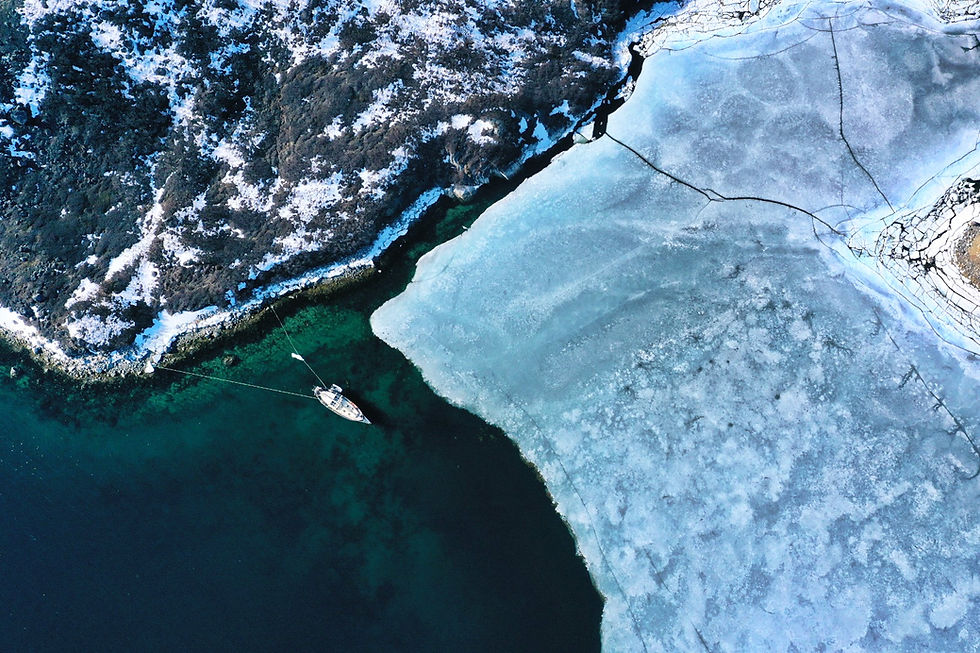
The next day, we continue sailing toward Ilulissat and, as expected, encounter a denser belt of ice. I can tell you that, up close, opportunities keep opening up, even though it may look impossible to get through from a distance. We track smaller motorboats on the chart plotter and slowly weave our way through the ice field. Suddenly, a fog bank approaches from behind, making the final miles to Ilulissat very eerie and exhausting. Four ships are already anchored off the town, and the only pier in the harbour is occupied by a military vessel. The density of the ice makes it clear that anchoring is not an option for us. The fog clears, and we continue on to Oqaasut. In Rodebay, off the small village, we're very well sheltered, as the larger icebergs can't get past the shallows at the bay's entrance.


An adventurous dinghy trip is on the horizon. Gregor has lost his dental crown again, but that just means he has another adventure to look forward to! He gets an appointment in Ilulissat. Bundled up in our flotation suits and with a gas can on board, we set out the next day in the dinghy, heading 8 NM toward Ilulissat. The ice density increases again just before we reach town, so we decide to head for a bay just outside the city. Then, we walk into town, which is just a short walk away. Gregor is in the very best hands! Feeling energised, we stop by a very well-stocked supermarket on the way back. With the low tide, the ice conditions along the coast have eased, and we're able to quickly and easily row the dinghy back to the Aegir without any problems. After this successful outing, we sit comfortably outside in the midnight sun and have our "seasonal barbecue" for this year. Once again this year, we are thrilled to share one of our favourite pastimes: collecting mussels or sea urchins at low tide. We can freeze several portions, which is great!


.
We continue through the Vaigat Strait, where sun and fog alternate. We anchor in beautiful bays, meet Inuit who live in tents like nomads during the summer, and enjoy a summer day on deck. It's mid-July, and our journey to Alaska via the Northwest Passage is drawing nearer. We participate in a "Remote Entry Procedure" pilot program run by the Canadian Border Services Agency. After filling out online forms, we undergo a phone check even before entry and receive confirmation of entry with our firearms. Now, we only have to send an email upon entry and exit. We're still dealing with our wind generator, watermaker, generator, and engine. We're setting the wind generator project aside as it cannot be integrated into our daily energy routine. However, we have successfully reactivated the watermaker after 8 months and are filling the water tank in 21 operating hours. To do so, the generator runs longer than usual. As for the generator, we're mostly dealing with loose hose clamps in the coolant and fuel systems. Last but not least, we've got quite a bit of engine oil in the bilge, which is really getting our hearts racing. It seems the problem's a full oil collector in the crankcase ventilation system. We've totally overlooked this little reservoir for the past four years, and it's supposed to be emptied with every oil change. Luckily, apart from a huge amount of oily sludge in the engine bilge, there are no other problems.

Heading to Upernavik, we take the inland route and drop anchor in Uluâ — a bay framed by granite cliffs. The steps are green and the slabs are wet from the rain. The scenery feels familiar. We've thought about it a lot and we've come to the conclusion that: The Aegir is anchored in a mountain lake in the Swiss Alps. It starts raining, and the view from our windows is like an autumn day looking out at snow-capped mountains. We spot loads of sea urchins and think they'd make a great meal. We collect a few with the fish net. So, after Gregor's research, we're eating them on bread first and then with pasta as "Ricci di Mare" — and it's delicious!

Next, we're heading to the village of Kangersuatsiaq (Prøven), where we'll get a closer look at Inuit hunting. Boats, gunshots, animals in the water—seals or whales? That's all we can make out. The cargo ship "Siuana Arctica" makes sure other goods get to where they need to go. We've already come across it a few times. In the morning, we're woken by the sound of propellers, and the ship drops anchor next to us. The aluminium tender (dinghy) is really sturdy and can bring the goods ashore. In Kangersuatsiaq, the old trading posts are used to store the goods. We buy four apples, and then we head on into the Laksefjord.

We picked the first spot, Akuliaruseq, and the granite cliffs as we got there were pretty impressive. For a moment, nature shares this area with us. We didn't see any locals, hardly any birds, one seal, an iceberg, and there was loads of greenery on land. The mosquitoes are starting to bother us a bit, so it's not too hard for us to head to the engine room in this lovely spot and do the last oil change before the crossing.

In April, we set sail from St. John’s—a journey of just under 2,200 nautical miles to Upernavik. We’re already 560 nautical miles from the Arctic Circle to Upernavik. So far, we’ve had a relaxing and varied time in Greenland. Now our adventure (the Northwest Passage) begins, with Alaska as our destination, after we’ve filled our diesel tanks and topped off our food supplies with a few fresh items.
The next blog post will be in the fall. If you’d like, you can follow our next major leg of the journey on Noforeignland, Predict Wind or—with a bit more visual content—FindPenguins.



Comments